If you love the cozy scent of ginger and maple syrup filling your kitchen, this Gingerbread House deserves a place in your holiday baking lineup. Made with real maple syrup and freshly grated ginger, the dough has the right balance of sweetness and spice. It’s thick enough to hold its shape while you build and decorate, yet tender enough that you’ll want to snack on the extra pieces.

This post contains affiliate links. As an Amazon Affiliate, if you purchase through those links, I earn a commission. Thank you!
I make these every December for Christmas parties and cookie exchanges because everyone loves building their own houses. Kids treat it like edible art while adults enjoy breaking off pieces for dessert later. The fresh ginger tastes more bakery-quality than store-bought kits. Store assembled houses at room temperature for up to 2 weeks, or freeze undecorated pieces for 3 months.
Ingredients You’ll Need
You’ll need all the ingredients shown in the photograph below.

How to Make a Gingerbread House with Step-By-Step Instructions
Scroll down for the full recipe card containing a full printable recipe and measurements in both US customary and metric units.
Start by gathering your ingredients and prepping your workspace, because this dough comes together quickly once you begin mixing.
Make the Dough
In a stand mixer with a paddle attachment or a hand electric mixer, cream the butter, brown sugar, and maple syrup on medium speed for 3 to 4 minutes, until the mixture is light, fluffy, and pale. I like using this stand mixer because it creams the butter more efficiently, freeing up my hands to prep the other ingredients.
Add the egg, freshly grated ginger, and lemon zest, and mix again so the batter becomes smooth and evenly combined.
Combine the Dry Ingredients
In a separate bowl, sift together the flour, allspice, cinnamon, baking soda, and salt to distribute the dry ingredients and remove any lumps.
With the mixer on low speed, gradually add the dry ingredients to the wet ingredients in 3 parts. Let each addition incorporate fully before adding the next to avoid overmixing.
The cookie dough will feel soft and slightly sticky at first, but it should come together into a smooth, uniform ball that retains its shape well.

SERIOUSLY GOOD
DESSERTS!
Dessert First is a collection of 61 RECIPES to show you that you can make beautiful, impressive desserts right in your own kitchen, no matter your skill level.
Immediate eBook download. No physical book available.
Includes ad-free recipes like:
∙ Lemon Pound Cake
∙ Starbucks Cake Pops
∙ Boston Cream Pie
∙ Chocolate Mousse
∙ Matcha Tiramisu
...and much more!

Chill the Dough
Divide the dough into two equal portions using a kitchen scale or by eye, then shape each into a rough ball. I always weigh my dough with a digital food scale because equal portions mean both batches bake at the same rate.
Wrap each portion tightly in plastic wrap to prevent drying, then gently flatten it into a disc with a rolling pin to make rolling later easier.
Place both discs in the fridge and chill for at least two hours, so the dough feels firm when touched. Chilling is an important step because it solidifies the butter, giving the dough time to rest and helping it retain its shape when baked.
Roll and Cut
Preheat your oven to 350°F (180°C) and line a few baking sheets with parchment paper.
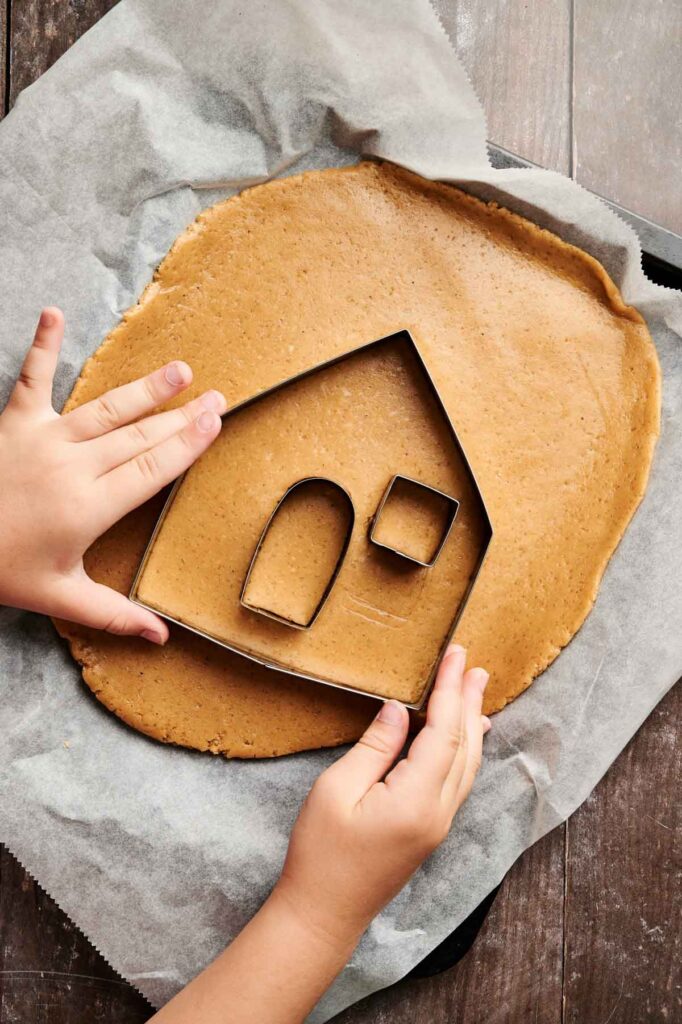
Remove one disc of dough from the fridge and let it sit for a couple of minutes to soften slightly, which makes it easier to roll. Put the dough between two sheets of parchment paper and roll it out evenly until it’s about one-fourth inch thick.
This thickness helps the pieces remain sturdy after baking. Lightly flour your cookie cutters to prevent sticking, then carefully cut out the house pieces, ensuring you have two of each side. I always grab my pastry cutter set for this because it includes multiple sizes, allowing me to make both house pieces and smaller decorative shapes from leftover dough.
Transfer the pieces to parchment-lined baking sheets, spacing them a few inches apart, and gather any remaining dough scraps to re-roll for additional pattern pieces or smaller cookies, such as stars, trees, or gingerbread people.
Bake the Gingerbread
Bake the larger house pieces for 18 to 20 minutes, watching for the edges to turn lightly golden and the centers to feel set when pressed. For smaller pieces, such as chimney or decorations, bake for 12 to 13 minutes to avoid overbaking.
Keep an eye on them in the final minutes, as smaller shapes can brown quickly. Once finished, remove the trays from the oven and let all the pieces cool completely on the baking sheets, allowing them to firm up and become sturdy enough to handle during assembly.
Make the Royal Icing
In a clean mixing bowl, beat the egg whites on high speed until thick, white, and fluffy for about 5 minutes. Add the sifted icing sugar and lemon juice. Mix on low speed until smooth and well combined.
Store it in a piping bag or sealed container at room temperature; do not refrigerate. Cover the icing to prevent it from drying out.
Assemble the House
Pipe icing along the edges of each gingerbread piece, starting with the front, back, and edges of the house. This reusable piping bag set is what I use because it gives me better control over the thickness of the icing lines.
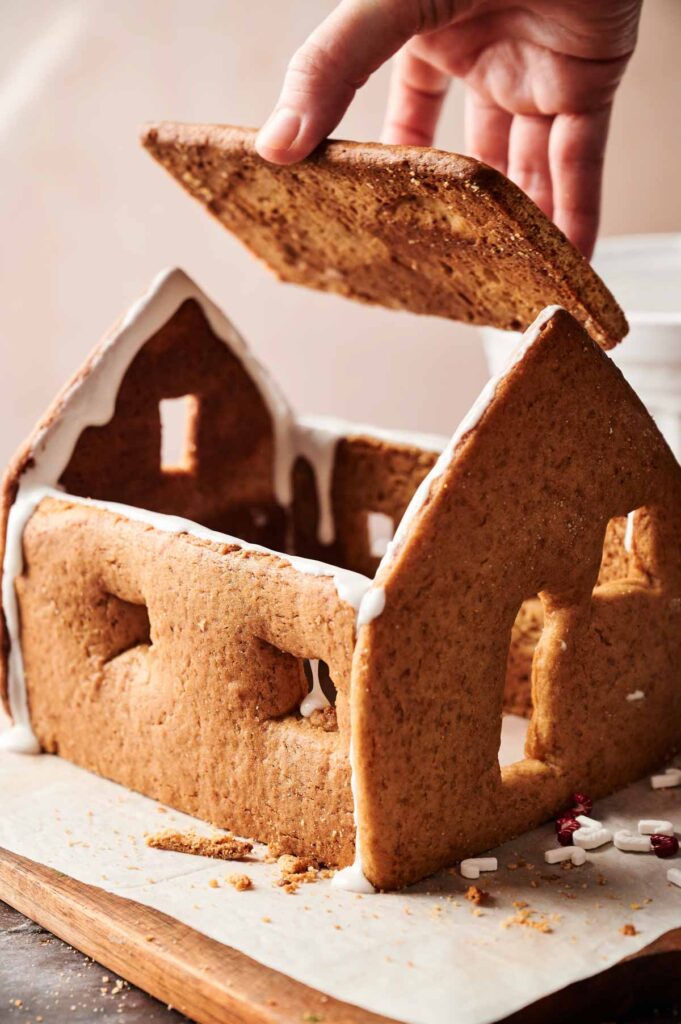
Press the walls together gently but firmly, holding each joint in place for a few seconds to help it set. Once the walls are stable, carefully attach the roof pieces, applying icing along the top edges and at the peak where the two panels meet.
If any pieces don’t align perfectly, trim them carefully with a sharp knife to get a better fit. Use cups or small jars to prop up the walls if needed while the icing sets. Let the structure sit undisturbed for at least an hour, allowing it time to firm up before decorating.
Decorate
Once the structure is firm and stable, you can begin decorating your gingerbread house with whatever you like. Use candies, sprinkles, or piped royal icing to create patterns, outlines, or borders.
Add powdered sugar for stiff peaks, a snowy effect, or create icicles along the roof with a fine piping tip. This is the fun part; feel free to get creative with color, texture, and design.
Let the decorations dry completely before moving or displaying the house.
Serve and Enjoy
Display your gingerbread house as a holiday centerpiece or break it apart to share with friends and family. The extra cookies made from leftover dough are perfect for serving on a dessert tray or as a gift. Enjoy!
I display mine on a 3 Tier Serving Tray because it makes a beautiful presentation and gives me enough space to arrange both the assembled house and individual cookies for guests to grab.
If you need to transport your gingerbread house to a party, holiday gathering, or gift exchange, I place it on a sturdy cardboard base, then set it inside a large box or an insulated casserole carrier with crumpled parchment paper around the sides to prevent shifting.
Keep the box level during transport and avoid stacking anything on top of it. The royal icing acts as a strong adhesive, but sudden movements can still cause pieces to shift or crack. Drive carefully and take corners slowly.

Gingerbread House
 Add Preferred Source
Ingredients
- 1 cup unsalted butter room temperature
- 1 cup packed light brown sugar
- 1 cup pure maple syrup
- 1 large egg
- 2 tablespoons fresh ginger grated
- 2 teaspoons lemon zest
- 4 ⅔ cups all-purpose flour
- 1 teaspoon ground allspice
- 1 teaspoon ground cinnamon
- 1 teaspoon baking soda
- 1 teaspoon salt
For the Royal Icing:
- 4 egg whites
- 4 cups icing sugar sifted
- 2 teaspoons lemon juice
Instructions
- In a stand mixer fitted with a paddle attachment, or using a hand mixer, beat the butter, brown sugar, and maple syrup together until light and fluffy. Add the egg, grated ginger, and lemon zest. Mix until well combined.1 cup unsalted butter, 1 cup packed light brown sugar, 1 cup pure maple syrup, 1 large egg, 2 tablespoons fresh ginger, 2 teaspoons lemon zest
- In a separate bowl, sift together the flour, ground allspice, ground cinnamon, baking soda, and salt.4 ⅔ cups all-purpose flour, 1 teaspoon ground allspice, 1 teaspoon ground cinnamon, 1 teaspoon baking soda, 1 teaspoon salt
- Gradually add the dry ingredients to the butter mixture in three parts, mixing on low speed until a smooth dough forms. The dough will be soft. Divide the dough into two portions. Wrap each in plastic wrap, flatten into discs, and chill for about 2 hours, or until firm.
- Preheat the oven to 350F (180C).
- Remove one disc of dough from the refrigerator and roll it out between two sheets of parchment paper to about one-fourth inch thick. Thicker pieces will make the house sturdier.
- Lightly flour the underside of your gingerbread house cookie cutters, then cut out the house shapes—two of each piece. Use any leftover dough to make fun shapes with smaller cookie cutters.
- Carefully transfer the cut pieces to baking sheets lined with parchment paper, spacing them about three inches apart. If any shapes get distorted, gently reshape the edges.
- Bake the larger house pieces for 18 to 20 minutes, or until the edges are lightly browned. Bake smaller pieces, like chimneys, for 12 to 13 minutes. Let all pieces cool completely on the baking sheets before assembling.
- In a clean mixing bowl, beat the egg whites on high speed until thick, white, and fluffy—about 5 minutes. Add the sifted icing sugar and lemon juice. Mix on low speed until smooth and combined.4 egg whites, 4 cups icing sugar, 2 teaspoons lemon juice
- Keep the icing covered to prevent it from drying out. Store it in a piping bag or sealed container at room temperature (do not refrigerate).
- Assemble the house by applying royal icing along the edges of each piece to “glue” them together. Start with the front, sides, and back, then finish with the roof. If any edges do not align perfectly, trim them carefully with a sharp knife.
- Once the structure is set, decorate your gingerbread house with powdered sugar, colorful sprinkles, candies, or any decorations you like.
Notes
- This recipe uses maple syrup, not molasses: Unlike traditional gingerbread cookies made with molasses, it uses pure maple syrup for a lighter, less bitter flavor, with hints of caramel that pair beautifully with fresh ginger.
- Chill before rolling: Chilling the dough is non-negotiable. It helps prevent spreading and ensures clean, sharp edges.
- Use a ruler for consistency: Check the thickness of your rolled dough with a ruler to ensure it’s a full one-fourth inch thick, which creates sturdy walls that won’t crack during assembly.
- Flour the cutters: Lightly flouring your cutters helps the shapes come out clean, especially for detailed house pieces.
- Pipe a thick line of icing: Apply a thick line of royal icing along all edges where pieces will connect, creating a stronger bond than thin piping and helping support the weight of the roof.
- Storage instructions: Store assembled houses at room temperature for up to 2 weeks, or freeze undecorated baked pieces in airtight containers for up to 3 months.
Nutrition
SERIOUSLY GOOD
DESSERTS!
Dessert First is a collection of 61 RECIPES to show you that you can make beautiful, impressive desserts right in your own kitchen, no matter your skill level.
Immediate eBook download. No physical book available.
Includes ad-free recipes like:
∙ Lemon Pound Cake
∙ Starbucks Cake Pops
∙ Boston Cream Pie
∙ Chocolate Mousse
∙ Matcha Tiramisu
...and much more!
How to Store Leftovers
Store your assembled gingerbread house at room temperature in a cool, dry place away from direct sunlight or heat sources. The house will stay fresh and sturdy for up to 2 weeks, though the royal icing may absorb moisture from the air in humid climates and become slightly softer.
If you want to preserve the house as a decoration without eating it, you can display it for several weeks or even months, but its flavor and texture will gradually decline. If you have undecorated baked gingerbread pieces left over, let them cool completely, then stack them between layers of parchment paper and store in an airtight container at room temperature for up to 1 week.
I always use these airtight containers with latched lids because they keep the gingerbread pieces crisp and prevent them from absorbing moisture or getting stale.
For longer storage, freeze the undecorated pieces in airtight containers for up to 3 months, then thaw at room temperature before assembling and decorating.
What to Serve With Gingerbread House
You can serve the broken pieces with vanilla ice cream, whipped cream, or cream cheese frosting for dipping. Kids especially love dunking the cookies into hot cocoa or decorating their own small pieces with extra royal icing and candies at holiday crafting parties.
More Easy Christmas Recipes for You to Try at Home
I’ve got plenty more Christmas recipe ideas for you to try at home.